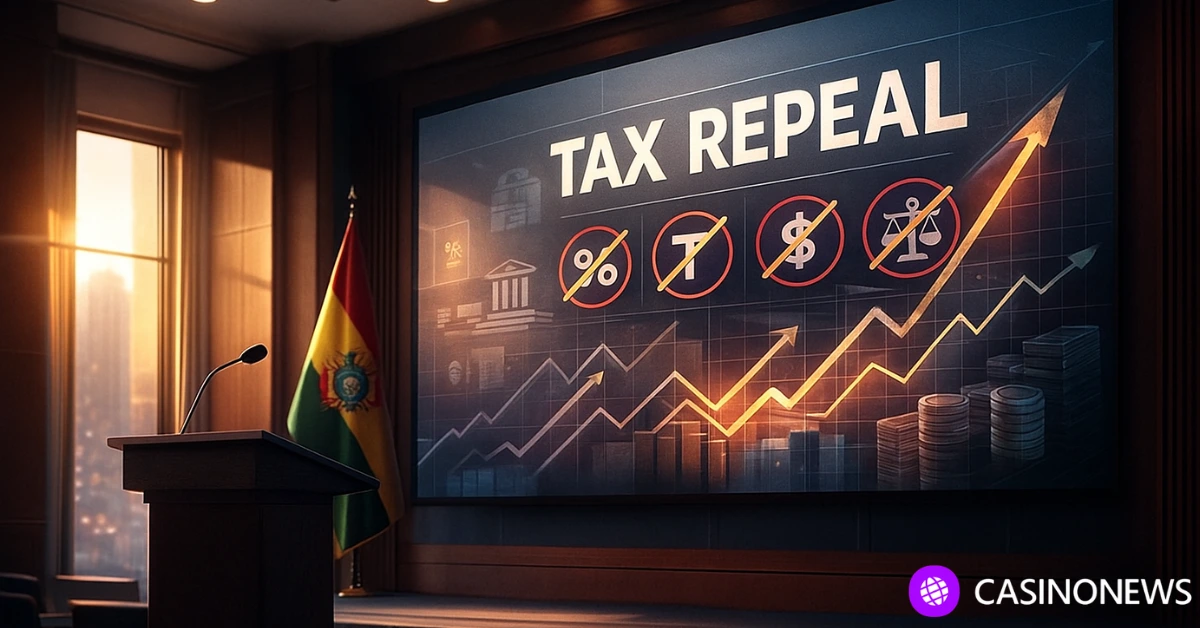
Bolivia’s new administration has opened its term with an ambitious plan to reset the country’s economic direction. President Rodrigo Paz is proposing the full elimination of taxes on games of chance as part of a sweeping fiscal overhaul aimed at restoring investor confidence, simplifying the tax system and reversing years of capital flight. The initiative sits within a broader legislative package that also seeks to repeal the wealth tax, the financial transactions tax and the corporate promotions tax.
Bolivia looks to overhaul outdated tax system
Paz argues that Bolivia’s existing levies on gambling and financial operations have not achieved their intended redistribution goals. According to government figures, the four targeted taxes together generate less than one percent of total fiscal revenue. Economy Minister Gabriel Espinoza says that once administrative and enforcement costs are taken into account, the net value to the state is negligible.
Officials believe the bigger issue is the economic damage caused by maintaining these taxes. The administration says regulatory uncertainty and fiscal pressure have discouraged investment and restricted growth in sensitive industries, including gaming. Instead of attracting capital into regulated sectors, the system has contributed to market contraction and weakened investor sentiment.
Capital flight strengthens the case for reform
The scale of capital flight has become a central argument for reform. Paz claims that roughly seven billion dollars has left Bolivia in recent years due to regulatory instability, with the wealth tax alone driving more than two billion dollars toward neighboring countries such as Paraguay. The government says gaming operators and other private-sector investors have withdrawn due to a lack of clarity and an unfavorable tax burden.
The administration’s message is clear: reducing friction is essential to rebuilding economic credibility. Removing the four taxes is presented as an early signal that Bolivia intends to become a more predictable, investment-friendly market.
Deep spending cuts aim to stabilize public finances
The tax proposal accompanies a planned thirty percent reduction in public spending for 2026, equivalent to around four percentage points of GDP. Espinoza says the goal is to eliminate waste, refocus resources on essential services and create an open market for long-term restructuring. The government has already begun consolidating ministries, cutting the number from seventeen to fourteen.
These moves come amid ongoing inflation pressures, fuel subsidy costs and a prolonged shortage of foreign currency. While changes to subsidies and the exchange rate were previously campaign commitments, Espinoza says adjusting them now would be too disruptive. The boliviano remains pegged at 6.96 per US dollar, even as a widening informal-market rate has increased import costs.
Government positions Bolivia as an investment-ready market
Removing gaming taxes is part of a wider attempt to attract domestic and international capital back into key sectors. By simplifying the fiscal landscape and reducing barriers to entry, the government hopes to stimulate activity in technology, tourism, financial services and entertainment. A more open environment for gaming could encourage local reinvestment and create opportunities for new operators to enter the market.
Business groups have welcomed the early steps. Bolivia’s Confederation of Private Entrepreneurs publicly supported the tax repeal initiative, calling it a critical move toward economic recovery. The government also confirmed that new external financing is underway, including an initial 550 million dollars from the Andean Development Corporation as part of a larger loan package.
Anti-corruption audits run alongside fiscal changes
Paz has also launched a broad audit of state-run companies and public institutions. At least ten investigative commissions have been created to examine alleged corruption and mismanagement across sectors such as hydrocarbons, telecoms, transport and lithium. The administration says irregularities under the previous government may total up to fifteen billion dollars, though these figures remain subject to investigation.
These oversight efforts are intended to complement the economic reforms, reinforcing the message that the new administration intends to rebuild both fiscal stability and institutional integrity.
What the tax repeal could mean for gaming operators
If approved by Parliament, the removal of gaming taxes would represent the most significant regulatory shift for the industry in more than a decade. The government argues it would:
- promote reinvestment
- attract foreign operators
- improve regulatory transparency
- support innovation and expansion
Critics warn that removing even minor revenue streams may introduce short-term budget pressure, particularly while subsidies remain in place. The administration maintains that long-term growth will outweigh any immediate fiscal reduction and that a more dynamic private sector is essential to reversing Bolivia’s economic trajectory.
The coming months will reveal whether the proposal gains parliamentary support and whether investors interpret it as a meaningful turning point. What is clear is that Bolivia is attempting a fundamental reset of its economic model, and the dismantling of gaming taxes is emerging as one of its boldest early measures.