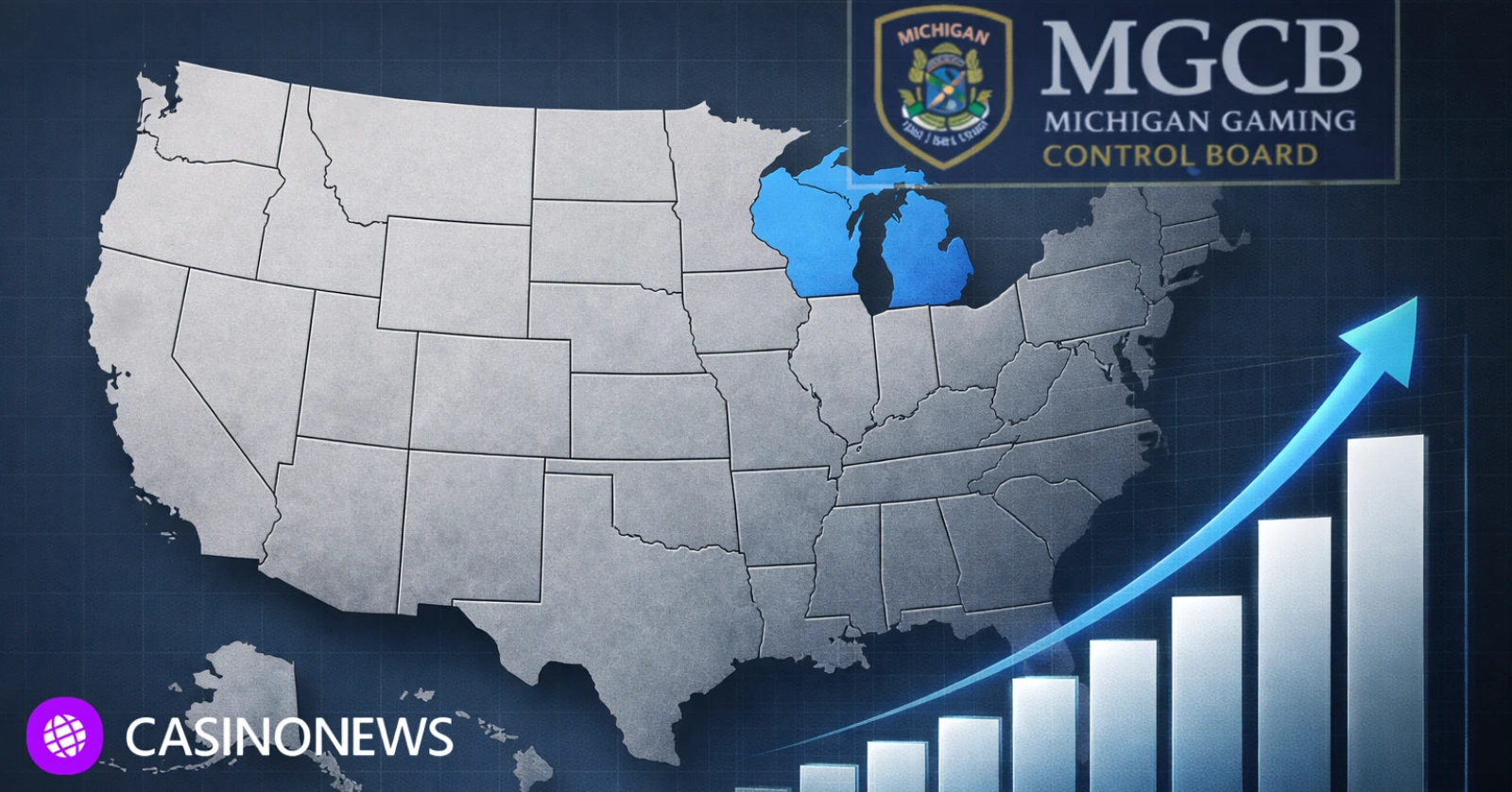
Michigan’s online gaming market opened 2026 with $356.3 million in combined gross receipts, according to figures released by the Michigan Gaming Control Board. The total covers both internet gaming and online sports betting activity for January.
The number is down 10.9 percent from December, a pullback that follows the typical post-holiday slowdown. Michigan remains one of the most established regulated online markets in the US, and January’s results show that its foundation continues to rest on online casino revenue.
iGaming continues to drive the market
Internet gaming generated $298.3 million in gross receipts during the month, while online sports betting contributed $58.0 million.
After promotional deductions, Adjusted Gross Receipts reached $323.3 million. Of that, $286.3 million came from iGaming and $37.0 million from sports betting. On a year-over-year basis, iGaming AGR rose 22.8 percent. Sports betting AGR, by contrast, fell 32.5 percent.
The gap between the two verticals is now a consistent feature of the market. Casino products generate steady, repeat engagement throughout the year. Sports betting revenue, meanwhile, fluctuates with the calendar and major event cycles.
Michigan set its iGaming record in May 2025 at $301 million. January’s performance sits just below that high-water mark, reinforcing how durable the casino segment has become.
Sports betting eases after late-year surge
Online sportsbooks handled $491.3 million in wagers in January, down 4.2 percent from December. The decline follows stronger activity in late 2025, including a record November.
A quieter event calendar and the fade from peak holiday betting contributed to the softer numbers. That pattern is familiar in most regulated states, where betting volume rises and falls with marquee sporting events.
Despite the volatility, sportsbooks remain central to operator strategy. They act as customer acquisition funnels, with players often moving into higher-margin casino products over time. January’s moderation looks cyclical rather than a sign of long-term contraction.
Tax revenue highlights fiscal weight of iGaming
Operators paid $57.1 million in taxes and payments to the state in January. Of that total, $54.6 million came from iGaming and $2.5 million from online sports betting.
Under Michigan’s regulatory structure, internet gaming taxes are directed into the Internet Gaming Fund. The proceeds support regulatory operations, responsible gaming initiatives, first responder programs, and contributions to the School Aid Fund.
The tax breakdown again makes clear where the fiscal strength lies. Online casino activity is the primary driver of digital gaming tax revenue in the state, providing a level of predictability that sports betting alone cannot match.
Retail casinos hold steady
Michigan’s brick-and-mortar sector continues to operate alongside online growth. Detroit’s three commercial casinos, MGM Grand Detroit, MotorCity Casino, and Greektown Casino, reported $103.08 million in adjusted gross receipts in January.
Those properties generated $8.35 million in state wagering taxes and $12.26 million in city wagering taxes and development agreement payments. Rather than displacing retail gaming, the online market has developed in parallel. The state’s hybrid model now appears settled, with both channels contributing meaningful revenue.
A stable, competitive landscape
As of January, 15 operators are licensed in Michigan. All offer internet gaming, and 12 provide online sports betting. The operator field has stabilized, with no rapid expansion or exits shaping the market.
The latest figures follow a pattern that has become familiar. Online casino revenue provides consistency and tax reliability. Sports betting adds reach and engagement but moves with the calendar. Together, they have positioned Michigan as one of the clearest examples of a mature and sustainable digital gaming market in the US.