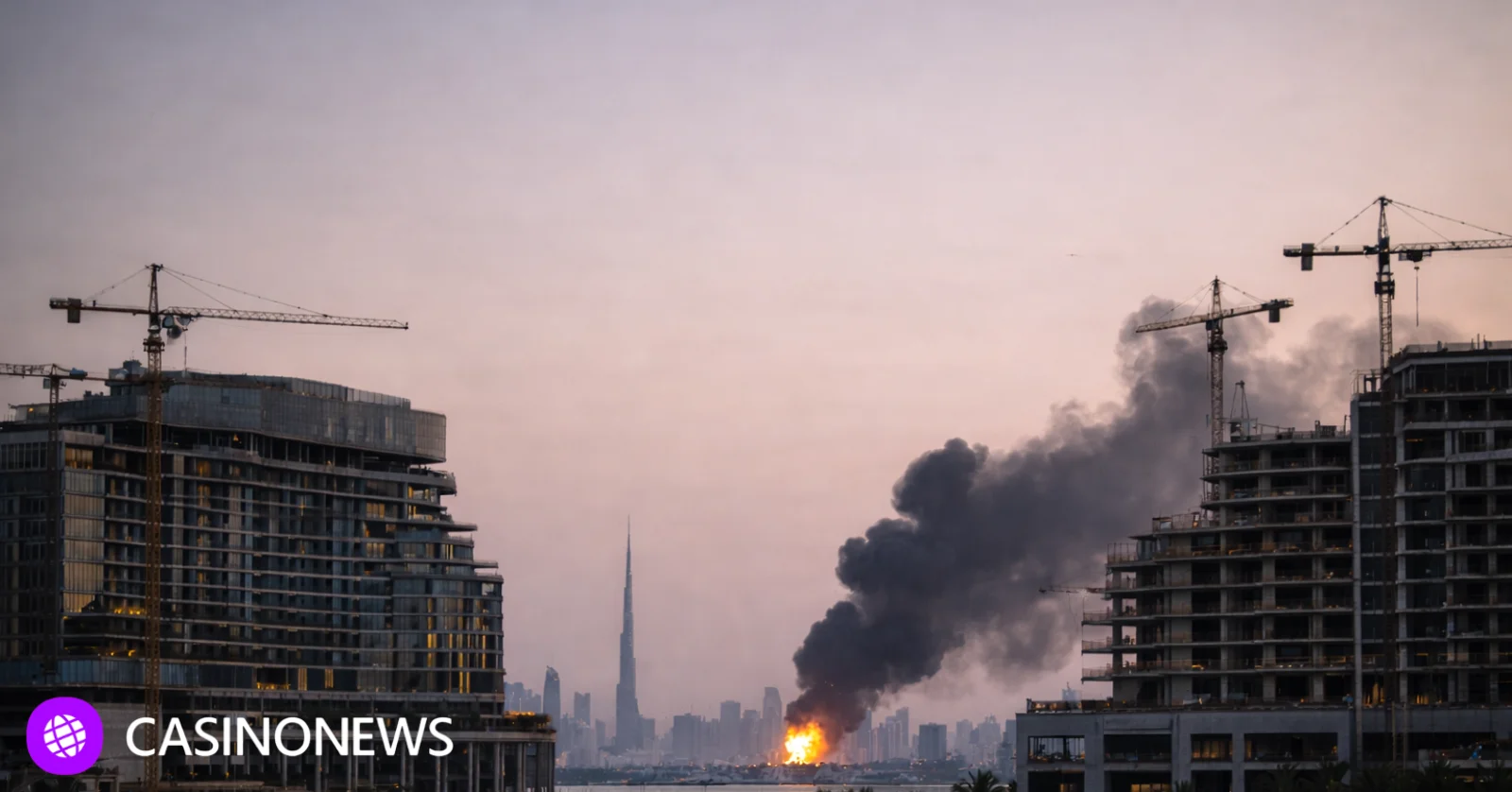
Wynn Resorts and MGM Resorts International are dealing with a risk that sits outside normal budgets and build schedules. Both groups are backing high-profile resort projects in the United Arab Emirates. Both now have to think about staff safety, supply chains, and whether the UAE can keep the sense of stability that makes billion-dollar tourism projects work.
The latest escalation has already hit projects key selling points. Air travel has been disrupted, infrastructure has been damaged, and the wider region has been pulled into a fast-moving conflict.
Travel disruption has put UAE projects under a harsher spotlight
Officials said debris from an aerial interception sparked a fire at a berth at Jebel Ali Port, one of Dubai’s most important commercial sites. Dubai International Airport also sustained damage during the attacks, adding to the disruption across Gulf airspace.
The fallout has not been limited to flights and logistics. The UAE shut its main stock exchanges for two trading days, then reopened on Wednesday with sharp losses in Dubai and Abu Dhabi Airlines.
Wynn’s Al Marjan resort is on a 2027 deadline
Wynn’s Ras Al Khaimah project is furthest along and already tied to a clear opening deadline. Wynn Al Marjan Island is marketed for a spring 2027 debut, and Wynn has positioned it as its next flagship resort.
The project also carries a regulatory first. Wynn has said it received the UAE’s first commercial gaming operator license from the General Commercial Gaming Regulatory Authority in October 2024.
On the ground, Wynn has said its employees in the UAE are safe and that it has plans in place to secure staff if conditions worsen.
MGM’s Dubai resort runs on a separate track, but the same risks
MGM’s Dubai development is not a casino, instead it will just be a branded hotel. The company has a non-gaming management agreement with Wasl Hospitality to bring the Bellagio, Aria, and MGM Grand brands to Dubai.
MGM has recently pointed to a third-quarter 2028 opening target for the hotel towers. That later timeline gives MGM more distance from the current disruption, but it does not remove the core risk. A project built on premium tourism needs steady air access, predictable staffing, luxury conditions, and a market that feels safe to visit.
MGM has since told outlets that its employees in the UAE were safe and sheltering in place under local guidance, with regular check-ins.
The bigger issue is confidence, not concrete
Neither company has reported direct damage to its development site. The immediate concern is what the disruption does to travel patterns, investor comfort, and the UAE’s reputation as a stable hub. The U.S. State Department ordered non-emergency government employees and family members to leave the UAE on March 2, citing the threat of armed conflict.
Air travel is the other pressure point. Thousands of flights have been cancelled across the region, and carriers have been forced into suspensions and are allowed limited schedules. For resorts that depend on uninterrupted tourism, even a short disruption can cause knock-on issues with bookings, group events, and future plans.
The UAE gaming story is now facing a real test
The UAE’s commercial iGaming shift has been built from the ground up to be safe: a federal regulator, early licensing steps, then a first flagship resort that would prove the model. That plan is still in place.
The question now is how investors and partners will react as the conflict develops. A regulator can write rules and enforce standards. It cannot control regional conflicts. So either way, the UAE’s plan for iGaming integration is going to be delayed due to the regions current instability.
A more complicated road to opening day
Wynn still markets a spring 2027 opening for Al Marjan. MGM still talks about Dubai as part of its long-term plan for international growth. Neither company has signaled a change in their direction.
But the way these projects are judged has shifted. Progress updates and licensing milestones still matter. So do softer questions that are harder to answer on an earnings call: how easy it is to move staff in and out, how quickly can operations resume, and whether lenders and partners treat the UAE as predictable again once the immediate disruption passes.