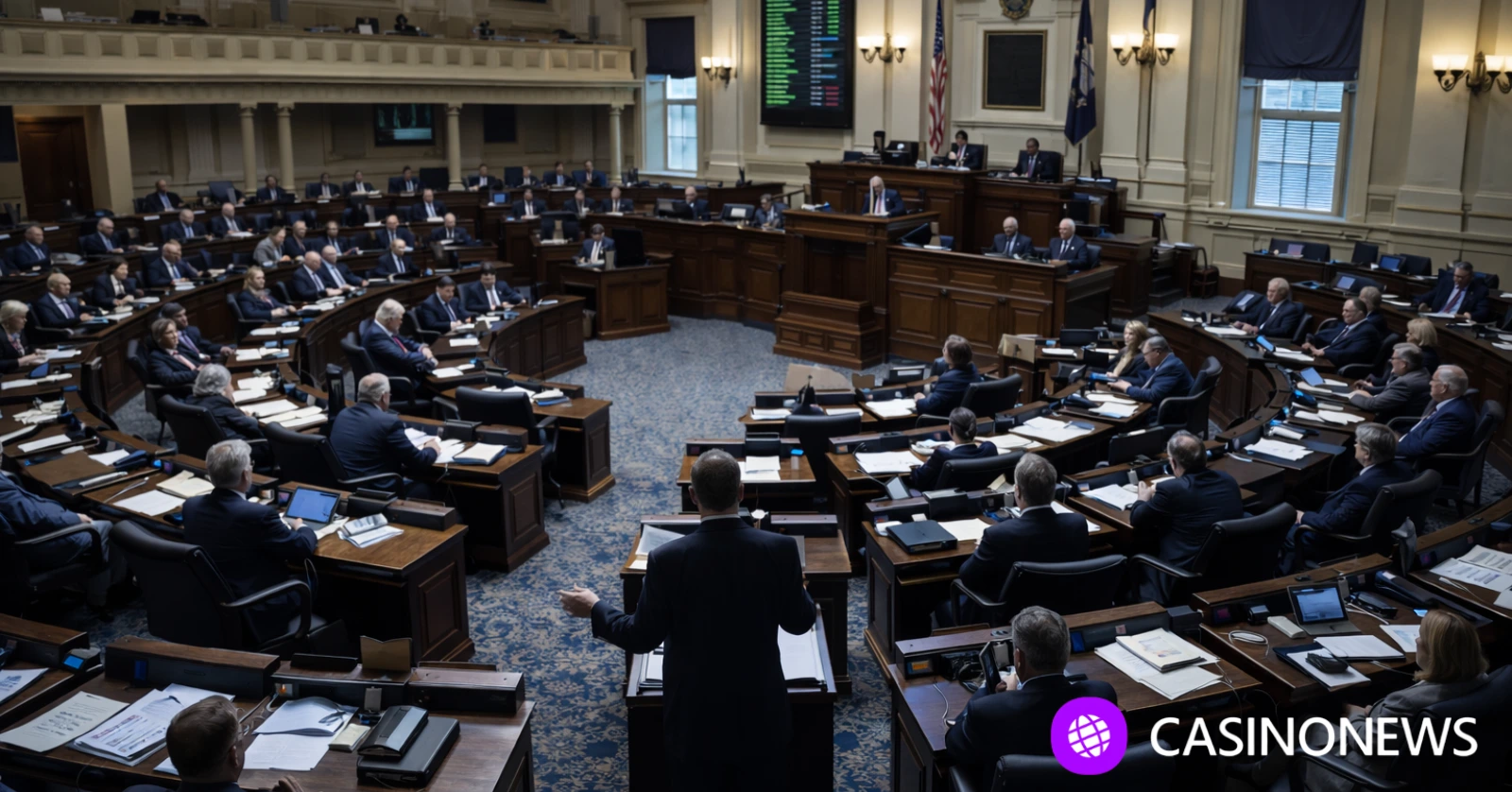
Virginia’s push to legalize online casinos remained alive Monday after surprise reversals on both the Senate and House floors kept companion bills moving forward.
The Senate first rejected SB 118 in a 20-19 vote before later reconsidering and advancing the measure 19-17, after several lawmakers shifted or declined to vote.
Senate reverses decision and advances the bill
It was a dramatic day for all those following the prospective legalization of online casino gambling in Virginia, with the Senate flip-flopping several times on SB118, initially voting it down 20-19 before voting in favor 19-17 after some last minute drop-outs.
Senators Bill DeSteph, Stella Pekarsky, and Schuyler VanValkenburg all declined to vote, forcing the bill over the line. The bill will now head to the lower chamber for consideration.
Meanwhile, a similar House measure to legalize online casinos, HB 161 sponsored by Delegate Marcus Simon, initially failed on third reading Tuesday in a 46-49 vote. Less than an hour later, lawmakers reversed course, approving the bill 67-30 on reconsideration.
The Senate bill is slated to come into effect by July 1, 2027, while the House bill must pass the Legislature next year before it can be legalized.
Under the proposal, operators would pay a $500,000 fee for a five-year license, with renewals set at $250,000. Each licensee could run up to three individual platforms, subject to a $2 million fee per platform.
The Joint Legislative Audit and Review Commission projects that online casino revenue in Virginia could climb to $845 million annually by fiscal year 2032.
Bill passages comes amid fraught debate on the floor
The discussion has exposed sharp divisions in the Senate, with opponents warning of addiction risks and supporters urging lawmakers to avoid what they call fear-driven rhetoric.
Senator Bill Stanley framed his opposition around smartphone dependency, telling colleagues: “And now, we’re being asked to put a slot machine on it. Let that sink in for a moment.” He argued that making casino games accessible “24/7 in bedrooms, bathrooms and school buses” is “not modernization but madness,” warning lawmakers not to ignore what he described as the broader social effects of constant digital access.
Senator Bryce Reeves, who previously chaired a joint subcommittee studying the feasibility of a Virginia Gaming Commission, said personal conversations shifted his position. “I just happen to be engaged to a forensic psychologist who works on addiction and she changed my mind to where I’m a no on this,” Reeves said. “After consulting with her and her telling me what we’re about to do to our youth, I can’t in good faith vote for this bill.”
Supporters pushed back against what they characterized as alarmism. Senator Mamie Locke cautioned colleagues against overstating the risks, saying: “I hope that we would not allow our emotions to overdramatize the future. We can torture the data until it confesses but that doesn’t make it true.” Responding to concerns about disproportionate harm, she added, “I’m certainly not one who’s about the business of harming the African-American community given that I’m a member of that community.”
Advancing bills come as Spanberger administration calls for state regulator
As legislation to expand gambling advances, the debate is unfolding alongside a broader push by the Spanberger administration to overhaul how the industry is regulated. Several bills this session seek to create a single state gaming commission, consolidating oversight of Virginia’s rapidly growing gambling market under one authority.
In a rare intervention, Secretary of Agriculture and Forestry Katie Frazier spoke in favor of a House proposal to establish the new regulator, signaling support from Governor Abigail Spanberger’s administration.
She said: ““Our patchwork approach is inefficient. It creates gaps in oversight and makes it more difficult to protect consumers, collect reliable data and ensure fair and responsible gameplay,
“Governor Spanberger is deeply concerned about any discussions of gaming expansion in Virginia without first establishing a single entity with clear authority, consistent standards and strong compliance and enforcement capabilities.”
Frazier described the House and Senate approaches as “different,” and did not publicly endorse the upper chamber’s version.
Illegal online casino gambling continues to pose issues in Virginia
Illegal online casino gambling remains a concern for policymakers in Virginia, where full-scale online casino gaming is not currently authorized under state law. While Virginia permits regulated online sports betting, casino-style internet gambling operates in a legal gray area or through offshore platforms beyond the reach of state regulators.
Lawmakers have acknowledged the issue in these recently-passed legislative proposals. Legalizing and regulating online casinos in the Commonwealth have included explicit penalties for operating without a state license, underscoring concerns that unregulated operators are already targeting Virginia players. Supporters argue a regulated market would draw consumers away from offshore sites that lack oversight and consumer protections.
The Sports Betting Alliance, an advocacy organization dedicated to legal, regulated online sports betting and online gaming in the U.S., says “legalizing and regulating online casinos would deliver $300 million in new annual revenue to support Virginia education.”
Under current Virginia law, unauthorized gambling operations remain criminal offenses. Regulators and industry observers say that without a legal, state-regulated online casino framework, enforcement challenges will persist, particularly as digital gambling platforms continue to evolve and market aggressively to U.S. consumers.