The sweepstakes casino industry received a boon in Massachusetts last week, after lawmakers delayed legislation targeting the sector to at least 2027.
Massachusetts House Bill 4431, which sought to ban or restrict their operations as part of a broader push to legalize and regulate online casinos in the state, has been selected for further review after a unanimous vote by the Joint Committee on Economic Development and Emerging Technologies.
Social Gaming Leadership Alliance (SGLA) hopes to work with lawmakers
Although the bill included provisions addressing sweepstakes casinos, those elements received far less attention than its central aim, which is to establish a legal framework for online casino gaming under the oversight of the Massachusetts Gaming Commission.
It is seen as a huge win for the sweepstakes casino industry, which has been under fire in numerous states across the US over recent months. It means platforms like Chumba, LuckyLand Slots, Stake, and Modo are able to remain in operation.
The SGLA has previously called on the government to create the conditions for a thriving landscape that has the interests of its players at heart.
Sean Ostrow, SGLA managing director, said of the decision: “The SGLA stands behind strong regulation and consumer protection, responsible social gameplay for adults only, fair taxation, and enabling economic development here in the Commonwealth. We look forward to working with members of this committee to achieve these mutually beneficial outcomes.”
According to the State House News Service, Rep. David Muradian Jr., the bill’s sponsor, said: “The momentum H4431 created this session will hopefully serve as a springboard to future economic growth in Massachusetts, while always focusing on consumer protections and safeguards.”
Sweepstakes casinos not so lucky in other states
A growing number of U.S. states are moving to restrict or ban so-called social casinos. While operators say the model is legal because it does not require direct wagers of cash, regulators and lawmakers in several states have argued the systems function too similarly to real-money gambling.
In Washington state, courts have taken one of the strongest stances against the model. A series of rulings, including a closely watched federal appeals decision, found that virtual chips used in some social casino games could be considered “things of value” under state law. That interpretation opened the door for lawsuits and effectively made the business model untenable for some operators in the state, signaling that even play-money systems can fall under gambling prohibitions.
Montana has also moved to tighten its approach. Lawmakers updated state law to clarify that online gambling, including certain sweepstakes-style and social casino offerings, is illegal unless specifically authorized. The change was aimed in part at closing perceived loopholes that allowed companies to operate in a gray area by offering free-to-play games alongside purchasable virtual currency.
In Michigan, regulators have taken a more targeted enforcement route. The Michigan Gaming Control Board has issued cease-and-desist letters to companies it says are offering illegal gambling under the guise of sweepstakes or social play. Officials have argued that when users can purchase virtual currency and redeem winnings for cash or prizes, the activity crosses the line into unlicensed gambling, even if framed as promotional gaming.
Other states, including Idaho and Nevada, have also drawn firm lines. Idaho prohibits most forms of online gambling outright, leaving little room for social casino operators that incorporate prize redemption. Nevada, home to one of the country’s most established regulated gambling markets, has similarly maintained strict controls, requiring any real-money or prize-linked gaming to fall under licensed frameworks.
Sports betting in Massachusetts to be taxed at 51% after bill passes
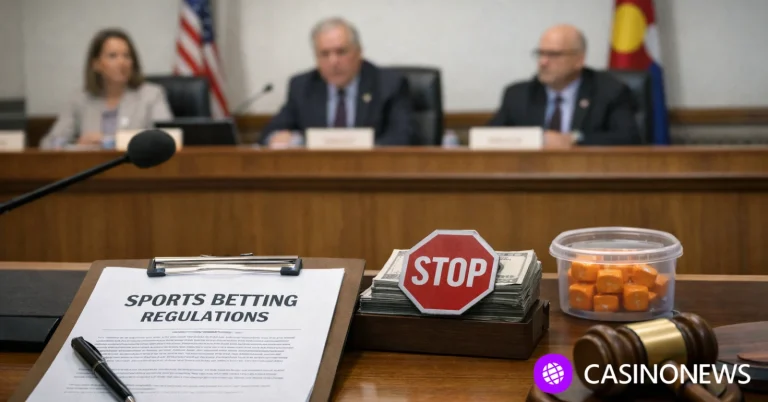
Elsewhere in the state, a bill aimed at overhauling Massachusetts’ regulated gaming market is advancing after a unanimous 5-0 vote from the Joint Committee on Economic Development and Emerging Technologies.
Senate Bill 302, known as the Bettor Health Act and sponsored by Sen. John Keenan, now heads to the Senate Ways and Means Committee. The legislation has been under consideration since 2025 and is gaining renewed momentum this session.
The proposal would reshape the state’s sports betting framework, including a major tax increase. It seeks to raise the tax rate on sports wagering revenue from 20% to 51%, aligning Massachusetts with states like New York. The bill would also boost annual funding for the Public Health Trust Fund from $1 million to $2 million and require operators to collect anonymized player data to study gambling addiction and identify high-risk behavior.
Keenan’s measure also targets how bets are placed, proposing a ban on in-play wagering and proposition bets amid ongoing integrity concerns. It would impose strict wagering limits, capping bets at $1,000 per day and $10,000 per month, while requiring affordability checks to ensure players are not exceeding 15% of their available funds.
The bill further tightens advertising rules, banning sports betting ads during televised sporting events and prohibiting promotions such as bonus offers and odds boosts. It would also eliminate VIP-style incentives tied to player spending. The legislation has backing from several lawmakers, including Rep. Lindsay Sabadosa and Sen. Patricia Jehlen.