The Mohegan Tribal Gaming Authority is throwing its support behind Connecticut’s push to rein in prediction market operators that tribal leaders argue are infringing on their exclusive gaming rights. The stance came as the casino operator posted a first-quarter profit, aided by a one-time accounting benefit.
Speaking on an earnings call Thursday, Mohegan Chief Financial Officer Ari Glazer said the tribe’s casino operations, alongside Foxwoods, are coordinating with state officials to address what he described as unauthorized sports wagering conducted through certain prediction market platforms.
Financial results provoke anxiety within authority
The rapid rise of federally regulated prediction markets is unsettling traditional gambling companies, which argue the platforms could sidestep the state-by-state tax and licensing systems that sportsbooks must follow.
Unlike casinos operating under the umbrella of the Mohegan Tribal Gaming Authority, prediction exchanges overseen by the Commodity Futures Trading Commission (CFTC) contend their sports-event contracts are financial derivatives rather than bets, allowing them to operate under a different regulatory framework.
Those realities are coming out to bear for Mohegan, which posted a first-quarter profit largely attributable to a one-off accounting adjustment rather than underlying operational growth.
For the quarter ended December 31st, the company reported net income of $108.5 million, reversing a net loss of $85.9 million in the same period a year earlier. However, the swing to profit was driven primarily by a $102 million non-cash gain tied to discontinued operations in South Korea.
Stripping out the one-time gain, first-quarter revenue was broadly unchanged year over year, while operating cash flow remained limited.
Analysts suggest further industry pressures will continue
The external pressure will only continue on the Mohegan Tribal Gaming Authority, according to Kim Noland, a high-yield analyst at Gimme Credit who covers the authority.
She wrote in a research note: “The company’s flagship Mohegan Sun Connecticut and the Poconos Pennsylvania casino both continue to report lackluster operations in the first fiscal quarter,
“Because some Mohegan bondholders not long ago agreed to restructure their debt, the company has a ‘runway’ to use cash flow from its bricks and mortar operations and the Digital unit to reduce debt and regain financial stability.”
A standout performer for the quarter was Mohegan Digital, the company’s online gaming and sports betting arm, which posted a 35.9% jump in revenue to a record $72.2 million. Growth was largely fueled by its Connecticut business, where gross gaming revenue climbed 33.5%.
It was the first quarter since the tribe’s CEO, Ray Pineault, stepped down after nearly 25 years with the authority. Announcing the news in a statement on October 17th, 2025, he said: “With Mohegan well-positioned for the future, including the expansion of online gaming, the time is right for me to transition from my role as President and CEO of Mohegan.”
Connecticut represents key battleground for prediction markets
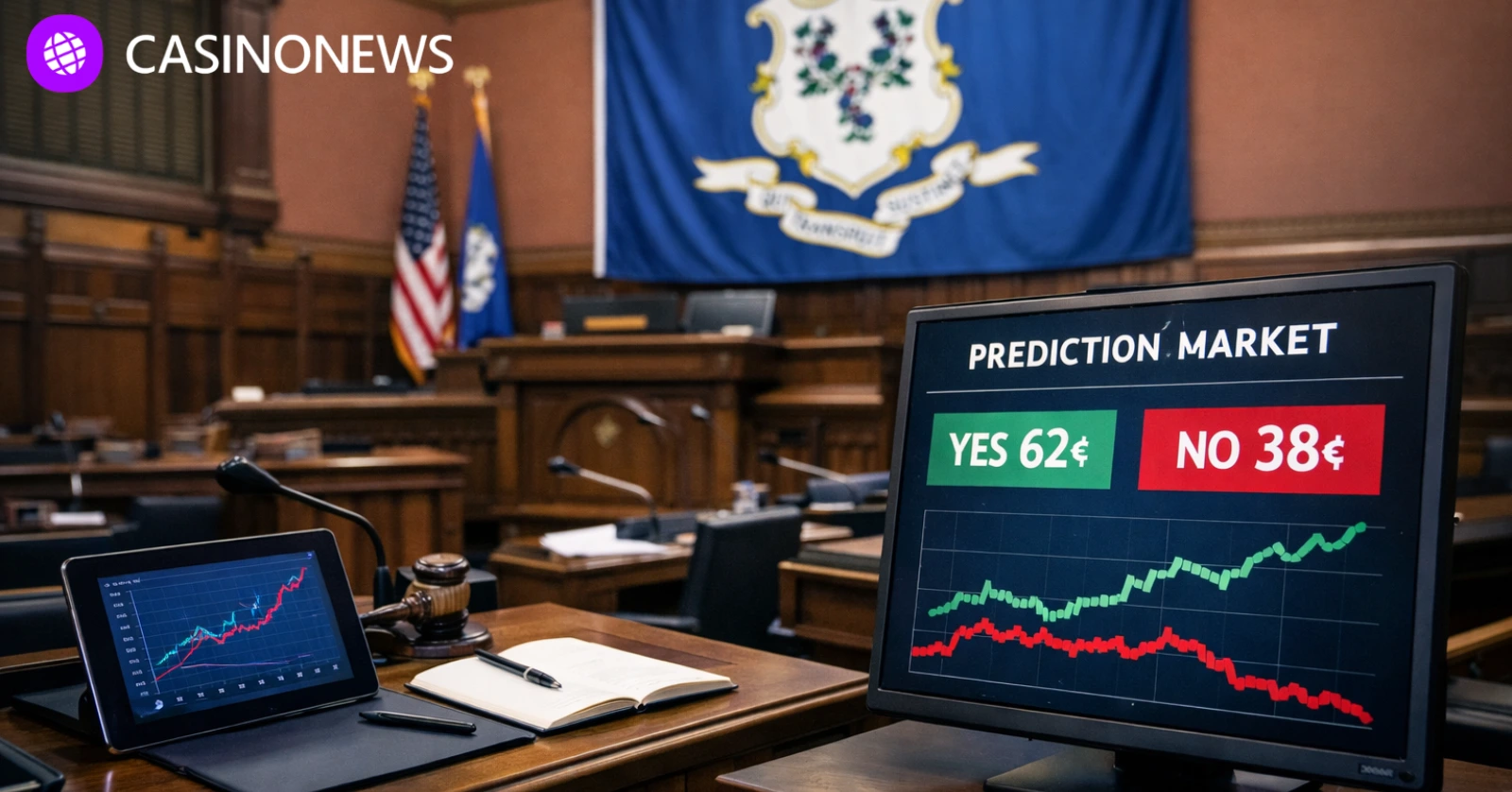
The Constitution State has become one of several flashpoints in the national debate over prediction markets, with state officials scrutinizing platforms that allow users to trade contracts tied to sports outcomes.
Regulators have signaled that such products may amount to unlicensed sports wagering under Connecticut law, placing them at odds with the state’s tightly controlled tribal-casino and sportsbook framework.
Indeed, Governor. Ned Lamont has proposed legislation that would bar prediction market platforms from admitting or marketing to anyone under 21, with fines of up to $50,000 for violations. The measure would also direct the Department of Consumer Protection, in coordination with the attorney general and the state’s two tribes, to study the impact of prediction markets on problem gambling and revenues tied to licensed operators.
Prediction market companies counter that their offerings fall under the jurisdiction of the CFTC, positioning the contracts as financial derivatives rather than traditional bets. That distinction has fueled legal and regulatory clashes nationwide, as states weigh whether the platforms bypass local tax structures, consumer safeguards and licensing requirements imposed on casinos and sportsbooks.
Connecticut’s legal response may shape how the balance between state gaming oversight and federally regulated event trading ultimately evolves.
Mohegan still dealing with fallout of losing South Korean casino
Mohegan has disclosed that it has lost control of its South Korea casino resort, Mohegan INSPIRE, after private equity firm Bain Capital seized the asset earlier this year. The development, located near Incheon International Airport, had been positioned as a major expansion of the company’s international portfolio but struggled to meet financial projections following its launch.
Bain Capital assumed control in February after Mohegan failed to satisfy certain financing obligations tied to the multibillion-dollar project. The resort, which includes a foreigner-only casino, hotel, arena and entertainment complex, was intended to capitalize on South Korea’s tourism growth but faced slower-than-expected ramp-up and high debt servicing costs.
The loss marks a significant setback for the Connecticut-based tribal gaming operator as it refocuses on stabilizing its balance sheet and core U.S. operations. Company filings show the transfer resulted in a substantial non-cash accounting gain in recent earnings, though analysts note the episode underscores the financial risks tied to large-scale international expansion projects.