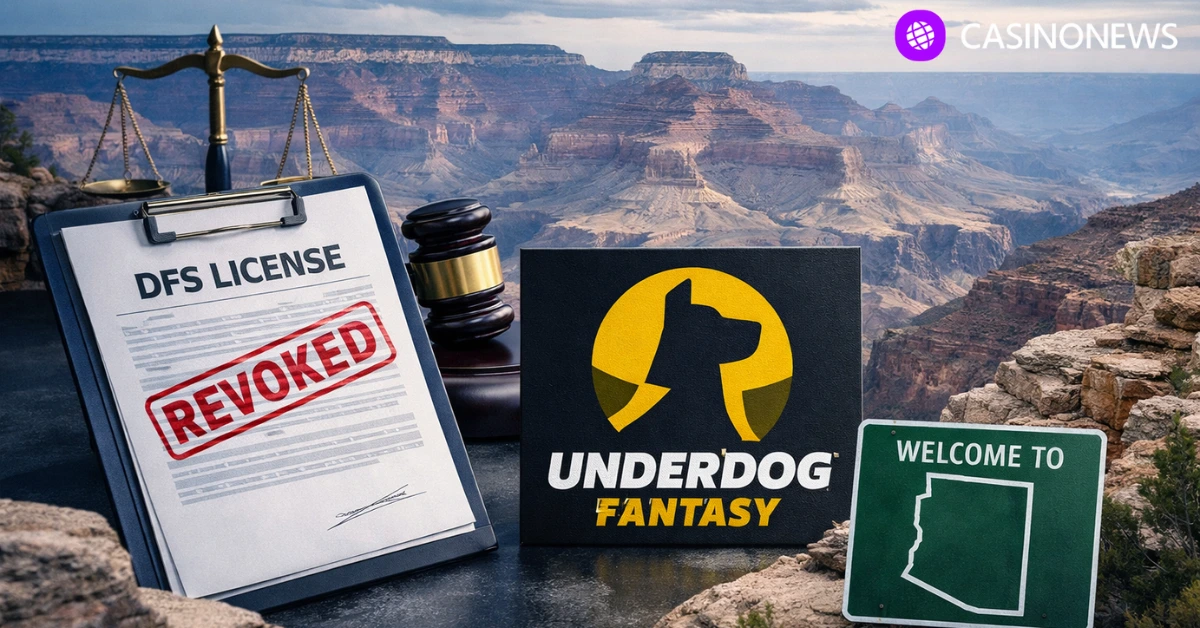
The Arizona Department of Gaming has decided to pull the plug on Underdog’s Daily Fantasy Sports (DFS) license, a policy leader for the Arizona governor’s office has confirmed. The company had been betting big on the market, and was offering sports event contracts through its partnership with crypto.com in two dozen states.
However, the state regulator had issued cease-and-desist orders to crypto.com after deeming the practice as illegal gambling earlier in the year. As a result, it sent a warning to Underdog back in September to advise against offering contracts or partnering with a company that does so.
Speaking to a gaming conference in Puerto Rico, Chris Kotterman said: “This was a very clear case that the operator was offering something in Arizona that we consider to be an illegal product.” He later confirmed Underdog’s relationship with crypto.com “affects their suitability”.
On Tuesday 17 December, a statement from ADG confirmed the decision. It said: “ADG has determined that Underdog, by contracting with Crypto, benefitting from Crypto’s services, supporting Crypto’s interests, and providing financial support to Crypto is aiding and abetting Crypto’s illegal conduct in Arizona and providing it with a façade of legitimacy.
“Moreover, and in the same fashion, Underdog’s relationship with Crypto is an association that poses a threat to the public interest of this State. As a result, the Department hereby provides Underdog notice of its intent to revoke [Underdog’s] fantasy sports contest operator license.”
Underdog set to appeal decision
The company has signaled its intention to overturn the ruling, arguing Arizona is attempting to “supersede federal law”. They will say that Crypto.com is a CFTC-regulated Designated Contract Market (DCM) subject to governance under the Commodities Exchange Act and not state law.
It’s a high-wire process. Failure to win this battle in court is likely to put it at risk in other states. It was handed the notice on December 5 and has 30 days to officially lodge its appeal.
If Arizona wins out, it is expected other states will feel emboldened to go after companies that work in tandem with prediction markets. The eyes of the sports betting world are fixed firmly on this case.
Underdog no longer operates traditional sports betting in the U.S. after relinquishing its Missouri license and announcing plans to shut down in North Carolina.
Arizona draws a hard line between DFS and prediction markets
It is the first time a state has pulled a DFS license based on a company’s specific prediction market activities and industry insiders are concerned it sets a precedent for the future. Analysts point to the use of strong language, such as “aiding and abetting” and “facade of legitimacy” as particularly pointed in the decision on whether to award a license.
Rather than focusing solely on whether Underdog directly offered an illegal product, the ADG appears to have framed suitability around whether the company benefited from, enabled, or failed to disengage from a partner whose conduct had already been deemed unlawful in Arizona.
It is the latest in a series of recent body blows for those who remain bullish on prediction markets. In Nevada, a judge ruled prediction betting platform Kalshi must operate under the state’s jurisdiction. While in Pennsylvania, the House Gaming Oversight committee talked up its intention to levy a state sports betting tax against firms that provide sports event contracts.
The state of play for sports betting in the Grand Canyon State
In industry-defining decisions such as this, the implications can extend beyond the operator directly involved. Arizona currently has 14 licensed sports betting operators, though only two, FanDuel and Fanatics, offer sports event contracts through prediction-market platforms in other jurisdictions.
Kotterman sought to limit concerns of broader industry fallout, emphasizing that the key distinction is Underdog’s status, noting that the company does not operate as a licensed sports betting operator in Arizona.
However, a line in the sand appears to have been drawn. By tying DFS suitability to off-platform partnerships and conduct in other jurisdictions, Arizona has signaled it is prepared to scrutinize not just what operators offer within state lines, but how they participate in the wider betting ecosystem. As legal challenges play out and federal and state authorities continue to clash over jurisdiction, the outcome of Underdog’s appeal may help define how far states are willing to go in policing the next generation of betting products.