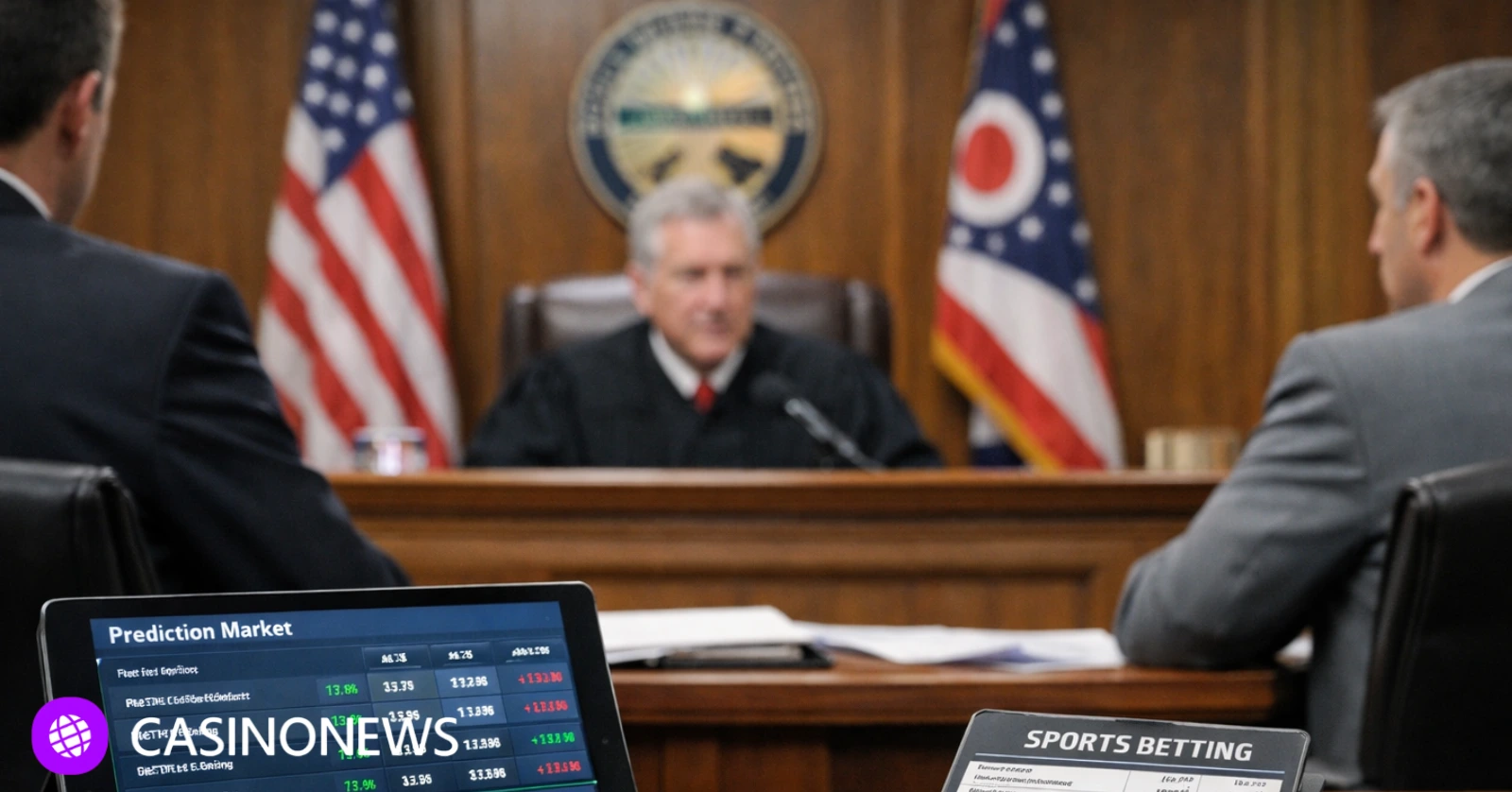
Prediction markets have been dealt another blow in the courts after an Ohio judge dismissed a request from Kalshi for an injunction against the Ohio Casino Control Commission (OCCC).
The authority is aiming to curtail Kalshi and other companies from operating as an “unlicensed sportsbook” that is “facilitating bookmaking”. It is the latest state, behind the likes of Tennessee and New York, to rule against the business.
Judge obligated to “avoid absurdity”
Delivering the ruling, U.S. District Court Judge Sarah Morrison argued Kalshi’s assertion that sports event contracts should be treated as federally regulated swaps did not hold up.
She explained that swaps are “understood as a transaction involving financial instruments and measures that traditionally and directly affect commodity prices.”
Elaborating, she wrote: “Currency exchange rates, the weather and energy costs all do that: the number of points scored in the Huskies-Bobcats game does not,
“This conclusion is further supported by the Court’s obligation to avoid absurdity. Ohio argues that absurd results would flow from defining a ‘swap’ to include a sports-event contract. The Court agrees.”
Ohio Attorney General Dave Yost was delighted with the verdict. He wrote on social media site X: “”Kalshi argued the federal Commodity Exchange Act preempts enforcement of Ohio law. Nope. These ‘prediction markets’ have exploded and look an awful lot like gambling. Big win for Ohio!”
Ohio latest state to clip wings of prediction markets
Ohio’s ruling adds to a growing list of states taking enforcement action against prediction market operator Kalshi over contracts tied to sporting events. Regulators in several jurisdictions have argued that the company’s event contracts function much like traditional sports wagers, meaning they should fall under state gambling laws rather than federal commodities regulation.
Tennessee was among the first to act earlier this year, when the Tennessee Sports Wagering Council issued cease-and-desist letters to Kalshi and other platforms, ordering them to stop accepting customers in the state and unwind existing contracts. Regulators said the markets amounted to unlicensed sports betting activity under Tennessee law.
New York has also taken a similar stance. The New York State Gaming Commission sent Kalshi a cease-and-desist letter alleging the company was offering “unlicensed sports wagering,” prompting the firm to file a federal lawsuit arguing that its contracts fall under federal oversight by the Commodity Futures Trading Commission (CFTC).
Nevada regulators have gone further, filing a lawsuit seeking to block the platform from offering sports-related event contracts to residents. The Nevada Gaming Control Board says such activity constitutes illegal gambling unless the operator holds a state gaming license, intensifying a broader legal clash over regulatory authority.
Other states have also stepped into the dispute. Massachusetts filed a lawsuit accusing Kalshi of operating an illegal sports wagering platform, while regulators in Connecticut, Maryland and New Jersey have pursued similar enforcement actions or regulatory challenges. Taken together, the growing number of cases illustrates the widening conflict between state gambling authorities and prediction market platforms over how sports event contracts should be regulated.
CFTC remains steadfast in support of prediction markets
The dispute has also drawn the attention of federal regulators. Last month, the CFTC signaled it intends to assert greater authority over the rapidly expanding prediction market sector, which has grown into a multi-billion-dollar industry.
CFTC chairman Michael Selig, a Donald Trump appointee, accused several state governments of attempting to undermine the agency’s jurisdiction. The regulator filed an amicus brief in federal court arguing that oversight of prediction markets should fall under federal commodities law rather than a patchwork of state gambling regulations.
In a Wall Street Journal opinion piece, Selig said the agency would not “sit idly by while overzealous state governments undermine the agency’s exclusive jurisdiction.” In a video posted later on X, he added that the CFTC wants to ensure prediction markets can operate in the United States with the same “integrity and resilience” expected of derivatives markets.
The regulator has also established a new Innovation Advisory Committee to help shape its approach to emerging financial technologies, including prediction markets. The panel includes representatives from companies such as Coinbase, CME Group, Nasdaq, Kalshi, Polymarket and DraftKings, and is expected to advise the agency on developing clearer rules as the market evolves.